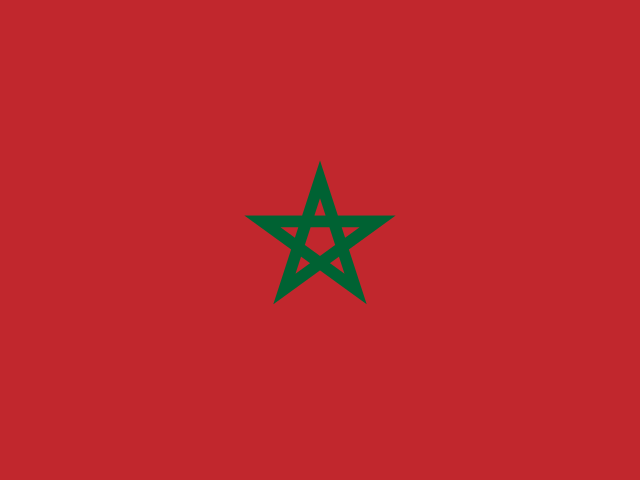
No-go for private B2C — closed state monopoly with active interdiction and offshore-winnings tax.
No T1 or T2 source for a market-size estimate, gross gaming revenue figure, or growth trajectory for Morocco surfaced this cycle. The commercial opportunity for new direct entrants is structurally constrained by the state monopoly model: both regulated verticals — sports betting under MDJS and the national lottery under SGLN — are operated exclusively by Sisal Jeux Maroc, a Flutter-owned vehicle.
There is no open competitive market in which a new operator could participate. The only addressable commercial opening visible from available evidence is the B2B technology supply route, which has become marginally more salient following the probable expiry of Intralot's MDJS technology supply contract at end-2025. No quantified estimate of the addressable B2B technology market is available from indexed sources. The absence of T1/T2 market-size data is a structural gap logged in the gaps register; a regulator annual report or industry-body data publication would be required to enable quantified market-opportunity claims.
No private operator licence is issued for sports betting or lottery — these are exclusive MDJS state monopolies under the Dahir, with SOREC holding horse-race betting and Loterie Nationale the draw-based lottery. Land-based casinos are licensed by the state case-by-case on 10–20 year terms in tourist cities. There is no online gambling licensing regime of any kind. B2B supply to MDJS is by direct contract (Intralot has been principal technology supplier since 2010), but no open B2B agrément class exists; supplying offshore grey-market operators serving Morocco creates legal risk. Poker has no standalone Moroccan statute and falls under the general prohibition on unauthorised games of chance.
Morocco offers no open competitive licensing pathway for direct operators. The sports betting vertical is governed by the MDJS monopoly, established in 1962 by Dahir — primary legislation carrying DURABLE status — which grants exclusive fixed-odds and pari-mutuel betting rights, excluding horse and greyhound racing.
The national lottery is governed by an equivalent durable statutory monopoly held by SGLN. Operation of both verticals has been delegated under concession to Sisal Jeux Maroc: the MDJS sports betting concession was awarded in February 2023 for an eight-year term from January 2024 with a two-year extension option, and the SGLN lottery concession has been held by Sisal since 2019. Both concession instruments are administrative delegations carrying FRAGILE durability. No new tender window was detected this cycle. The only entry pathway available to a foreign entity is as a B2B technology supplier to the state monopoly operator, a route that has become potentially accessible following the probable expiry of Intralot's MDJS technology supply contract at 31 December 2025, though no public tender or successor appointment has been announced.
No player protection regime applies to private online gambling operators in Morocco. The sector is prohibited, and the absence of a licensing framework means there are no self-exclusion requirements, deposit limits, age-verification mandates, or responsible-gambling operational obligations directed at private operators. MDJS operates responsible-gambling measures under its state-monopoly framework, but the detail of those measures is not publicly available. The most significant development in the player-protection space this cycle is the probable emergence of 2026 draft laws targeting minor protection through age verification and parental controls; these are fragile instruments not yet enacted and do not constitute an operational framework for private operators. ANRT has, on a probable basis, taken a more active role in monitoring digital platforms with a focus on protecting younger users. Private gambling marketing directed at Moroccan residents — including marketing to minors — is unlawful under the confirmed durable statutory framework.
MDJS markets its own products through state-controlled channels; private gambling marketing to Moroccan residents is unlawful. A late-2025 MDJS push targets social-media pages promoting unlicensed operators, and ANRT has taken a more active role monitoring digital platforms, particularly for minor protection. Bonus and sponsorship marketing by private operators is effectively banned.
App stores block gambling apps for unlicensed operators targeting Morocco-based users; ANRT can pursue app-store removals. No legal affiliate distribution exists. Google and Meta require compliance with local law for Moroccan-targeted gambling advertising, effectively blocking unlicensed-operator ads.
In January 2026 the Casablanca Commercial Court, on an MDJS complaint, ordered Maroc Telecom, Orange Maroc and inwi to block offshore betting sites (1xBet, Stake, Betway) by DNS/IP blocking, with daily fines of MAD 10,000 for non-compliance. On 10 February 2026 the Casablanca Court of Appeal stayed the order, finding the telecom regulator exceeded its statutory mandate, leaving offshore sites accessible pending final ruling. Enforcement intent is punitive but currently in legal flux; the principal interdiction tools are ISP blocking and a 32% tax-at-source on offshore winnings.
No Morocco-specific gambling enforcement action or liability development surfaced this cycle. The monopoly framework — grounded in the DURABLE Dahir establishing MDJS (1962) and the equivalent durable statutory basis for SGLN — implies that any operation outside the state concession structure would face enforcement exposure under the statutory licensing stack: in a civil-law jurisdiction of this type, gambling is licit only under the explicit permission of the enabling statute, and operation without a concession constitutes an offence under the gambling statute itself. However, no specific Moroccan enforcement instrument, penalty schedule, blocking mechanism, or case-law evidence was indexed this cycle, so the enforcement theory must be characterised as structurally inferred from the civil-law framework rather than evidenced by primary sources. No enforcement-event pattern can be described. The absence of indexed enforcement evidence is a structural gap; primary-source confirmation of the enforcement regime would be required before the enforcement picture can be assessed with confidence.
No Morocco-specific gambling-sector AML/CFT evaluation finding surfaced this cycle, and no T1 or T2 source for Morocco's domestic AML legislative framework as applied to gambling was indexed. The jurisdiction's gambling law derives from a French civil-law tradition, and Morocco is not an EU member state, meaning EU Anti-Money Laundering Directive transposition triggers are structurally inapplicable.
The relevant AML/CFT watch-item this cycle is regional: FATF and European Commission high-risk and grey-list activity in the wider Maghreb intensified, with Algeria and Monaco added to relevant lists. This is a probable forward signal for Morocco — a future MONEYVAL or FATF mutual evaluation action touching Morocco's gambling sector would carry direct customer due diligence and enhanced due diligence implications for the MDJS and SGLN concessionaires — but no Morocco-specific trigger fired this cycle. The practical AML/CFT burden on the state monopoly concessionaires cannot be assessed from available evidence; no STR/CTR threshold data, designated reporting entity classification, or tipping-off provision evidence was indexed. This is a structural gap requiring a Morocco-specific FATF mutual evaluation report or domestic AML legislation publication to resolve.
No certification or technical-compliance regime applies to private online operators (none are licensed). Morocco imposes no sector-specific gambling AML/KYC, data-localisation, or responsible-gambling technical standards. ANRT has sophisticated internet infrastructure and has taken a more active role monitoring digital platforms; ISP-level DNS/IP blocking is the principal interdiction capability, though its statutory basis is contested following the Feb 2026 appeal.
No operational obligations apply to private online gambling operators in Morocco. The sector is prohibited under primary legislation — Dahir No. 1-65-206 (1966) — and the absence of a licensing regime means there are no reporting obligations, no technical certification requirements, no responsible-gambling operational mandates, and no distribution platform rules applicable to private operators.
MDJS operates under state procurement and public-sector governance rules as the monopoly holder, but the detail of those obligations is not publicly available. Land-based casino operators are subject to concession-term obligations, but these are not publicly detailed and are not relevant to online operators. The operational obligations picture for private online operators is therefore structurally null: the prohibition itself is the operative constraint, and no compliance pathway exists through which operational obligations could be discharged.
The cost-to-operate framework for private online operators in Morocco is defined by the absence of a licensing regime rather than by its content. There is no private operator licensing fee, no technical certification cost, and no formal AML or responsible-gambling compliance obligation directed at private online operators, because the sector is prohibited. The relevant cost dimension is the interdiction burden on offshore operators serving Moroccan residents. The 2025 Finance Law introduced a confirmed 30 percent withholding tax on offshore winnings — reported as 32 percent effective inclusive of the 2 percent solidarity contribution — collected at source via the domestic banking system. Office des Changes foreign-exchange controls restrict capital outflow to offshore operators, adding a structural payment friction. Crypto gambling is explicitly banned, removing a common cost-reduction workaround. Land-based casino operators face a probable tax rate of approximately 30 to 40 percent of gross gaming revenue under their concession terms. For any operator contemplating the offshore market, the withholding tax and FX controls represent the primary cost and access barriers.
No private operator gambling-tax regime exists for online entrants; MDJS revenues are remitted to the state. The 2025 Finance Law introduced a 30% withholding tax (reported as 32% effective with a 2% solidarity contribution) on winnings from foreign online gambling platforms, deducted at source by banks. Land-based casino tax is reported in the 30–40% of GGR range.
No private operator licensing regime exists for online verticals, so no application or annual fee schedule applies to entrants. MDJS operates as a state concession with internal financial arrangements remitting revenue directly to the state. Land-based casino licences are negotiated case-by-case with the state.
The payments and money-flow environment for offshore gambling operators serving Moroccan residents is materially constrained. The 2025 Finance Law introduced a confirmed 30 percent withholding tax on offshore winnings, collected at source via domestic banks — a mechanism that engages the banking system as an active interdiction layer rather than a passive conduit. Office des Changes foreign-exchange controls restrict capital outflow to offshore operators, confirmed as a durable structural barrier. Crypto gambling is explicitly banned, with crypto-wallet use to circumvent FX controls prohibited under FX law — closing the most common alternative payment route. E-wallets including Skrill and Neteller are used by sophisticated bettors to navigate FX controls, but this operates in a legally precarious environment. Bank transfers are technically permitted as a funding method but are subject to the withholding tax at source. No formal payment-blocking order directed at financial institutions has been documented beyond the banking withholding mechanism; the ISP blocking order that was stayed in February 2026 targeted telecommunications providers rather than payment processors.
Moroccan banks deduct the 32% offshore-winnings tax at source and Office des Changes FX controls restrict capital outflow to offshore operators. Crypto gambling is explicitly banned, with crypto-wallet use prohibited to prevent circumvention of FX law. Sophisticated bettors use e-wallets (Skrill, Neteller) and local cards (BMCI, Attijariwafa) to fund accounts, but financial transactions remain visible to banks and processors. No permitted payment rails exist for private offshore operators.
The Moroccan gambling competitive landscape is a state monopoly with concession operation concentrated in a single entity. Sisal Jeux Maroc, a Flutter-owned joint venture, holds operating rights to both the MDJS sports betting monopoly and the SGLN national lottery monopoly, making it the sole licensed commercial gambling operator in the two regulated verticals.
No licensed operator count beyond this single concessionaire is available from indexed sources, and no quantified estimate of unlicensed market share surfaced this cycle. The competitive dynamics of the market are therefore defined entirely by the regulatory structure rather than by competitive interaction between licensed operators. The principal competitive-dynamics event this cycle is the expiry of Intralot's 15-year technology supply relationship with MDJS at end-2025 — a supply-chain transition that does not alter the concentration of the licensed market but does introduce uncertainty into the technical infrastructure underpinning the monopoly operation. No successor supplier arrangement has been confirmed.
The prohibition/monopoly structure is stable, but the online frontier is in flux. The 2025 Finance Law's offshore-winnings tax is the first formal fiscal step recognising offshore activity, and 2026 draft laws target minor protection (age verification, parental controls). Industry-government forums discuss potential future online licensing, but Islamic-law and political constraints make a private online regime uncertain in the medium term.
Direction is mixed: tightening on enforcement and fiscal capture, tentatively constructive on future regulation.